On the second-hand market, recent catamarans under 13 meters (43 feet) in length are few and far between… and often seem to be listed at prices close to those of new boats. But among them, the Leopard 42 deserves attention, if only because it’s being replaced by the Leopard 43, making it a pre-owned catamaran. Designed from the outset to appeal to both private owners as well as charter companies, and with over 200 examples sold, this model already has a wide selection available in the classified ads. Its main strengths are a robust design and proven practicality. So, is this model, launched in 2020, already a good deal?
Infos pratiques
- Le chantier : Leopard 42 (2021)
- La fiche technique
-
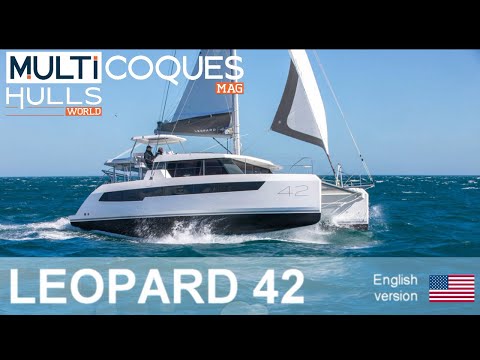 Découvrez notre vidéo exclusive
- Financez votre Leopard 42
- Assuez votre Leopard 42
- Articles autour du Leopard 42
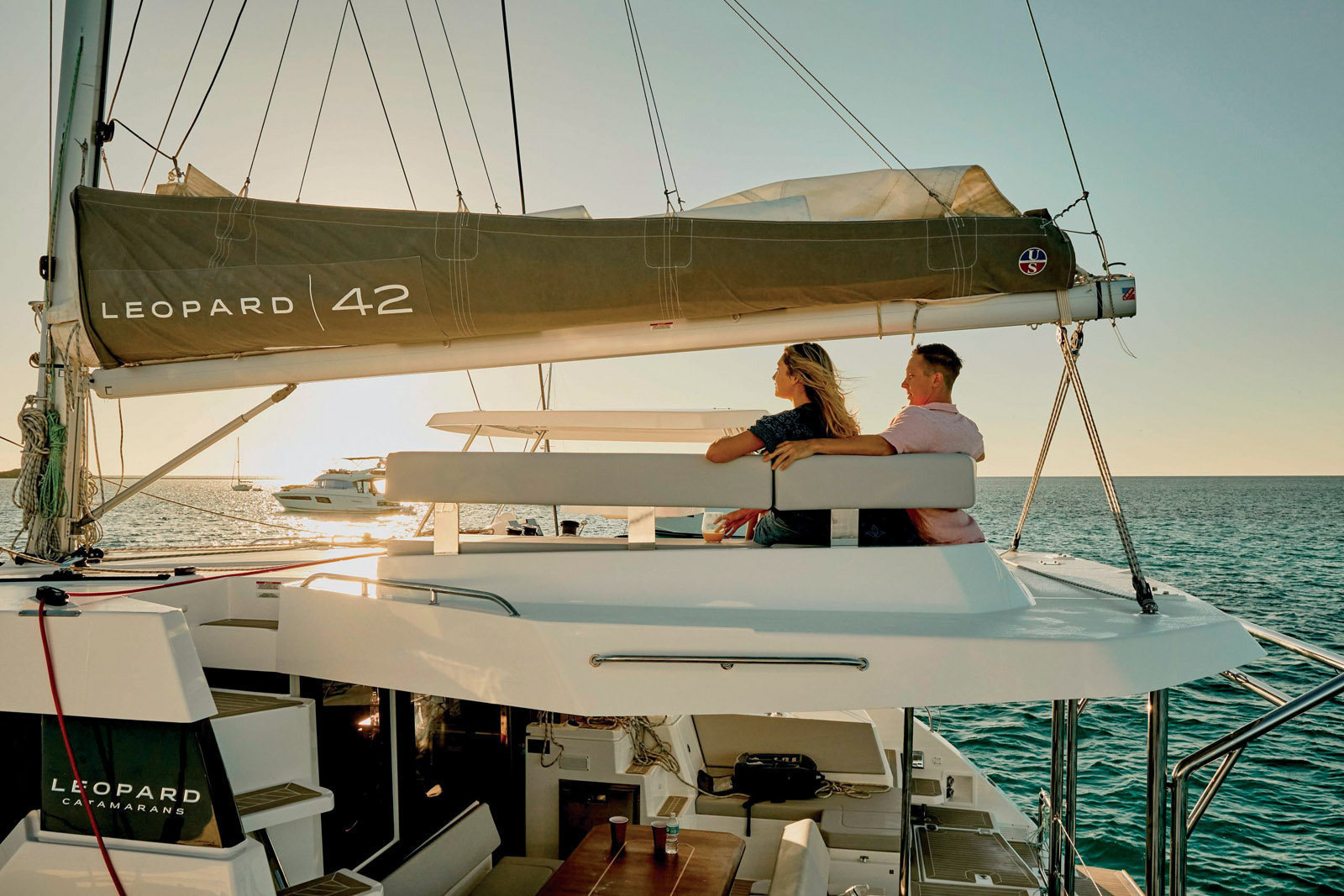
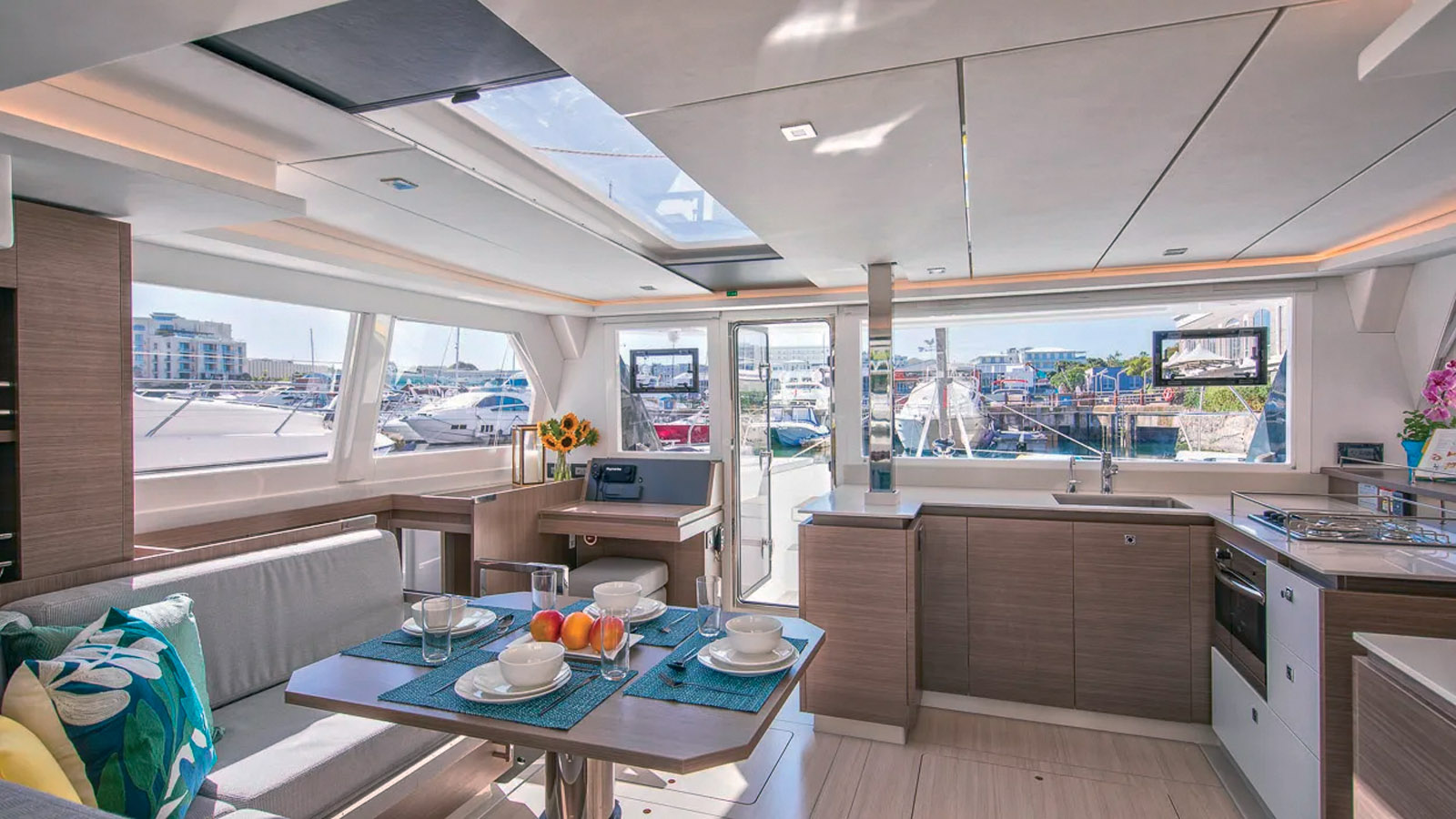
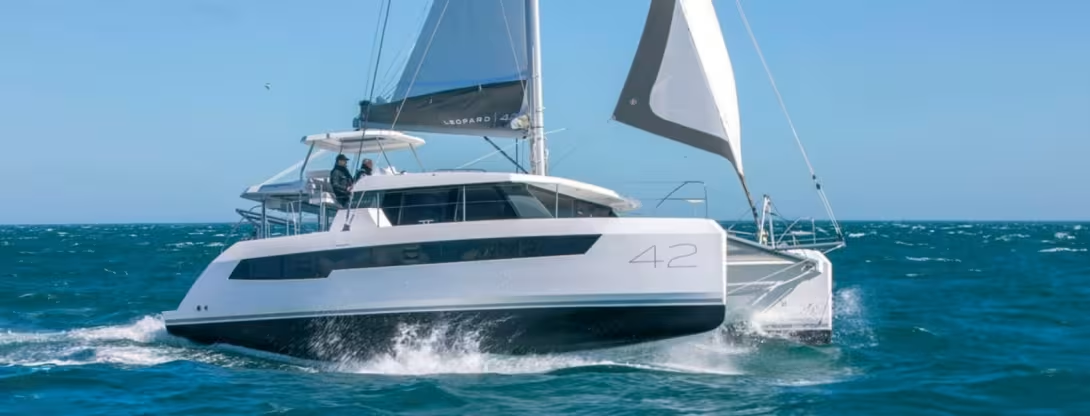
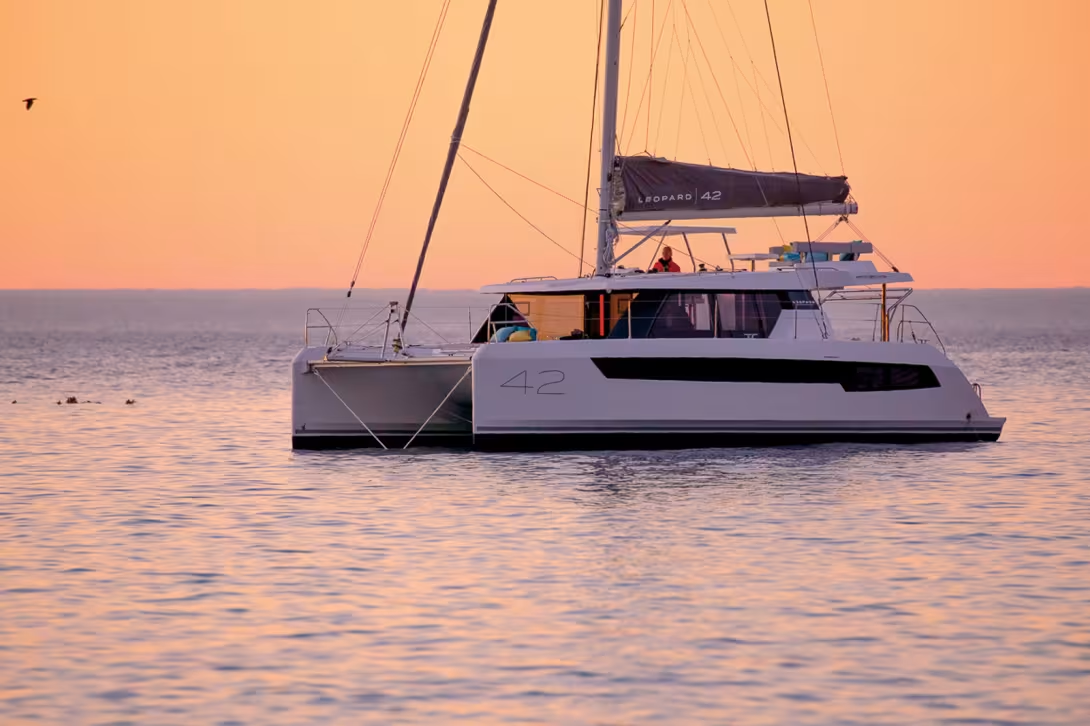
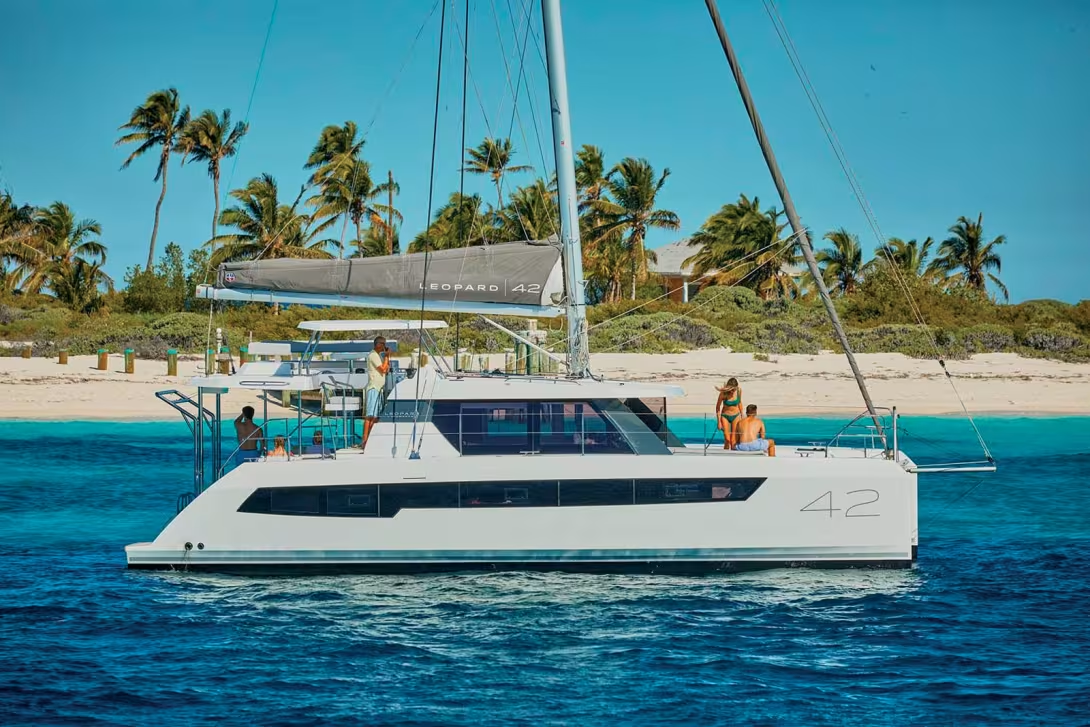
The Leopard 42 was not simply an evolution of the 40 but marked a genuine stylistic break within the range. Inspired by the Leopard 50, it features continuous side windows, a redesigned coachroof, including a lounge area actually on the roof, and a significantly brighter nacelle. In terms of design, the lines are modern but lack a bit of originality. Still, the designers’ goal was clear: to preserve the brand’s distinctive maritime DNA while meeting the expectations of a new generation of owners, who are more concerned with onboard comfort than with pure sailing performance.
Construction Designed to Last
With this model, Leopard remains true to the formula that has made its reputation. The brand’s catamarans are all built by a shipyard founded in 1991 in Cape Town by John Robertson and Jerry Caine. In fact, Robertson & Caine has established itself over three decades as one of the world’s leading catamaran builders (with some 3,000 now launched), largely thanks to its long-standing partnership with Moorings and Sunsail. This professional clientele demands very stringent specifications: the multihulls must be capable of withstanding thousands of hours of sailing, by crews that are sometimes inexperienced, and intensive rotations.
The Leopard 42 thus benefits from a particularly rigid structure. The shipyard has notably reinforced the hull-to-deck joint, expanded the use of infusion molding, and integrated a metal beam into the forward structure to minimize any deformation. The skeg keels, meanwhile, are designed to give way in the event of a violent grounding without compromising the integrity of the hulls.
This structural robustness largely explains the excellent reputation that Leopards enjoy in the second-hand market. Specialized brokers regularly highlight how well these boats hold up over time, even when they’ve originated from charter programs.
More for Owners Than for Charter Work?
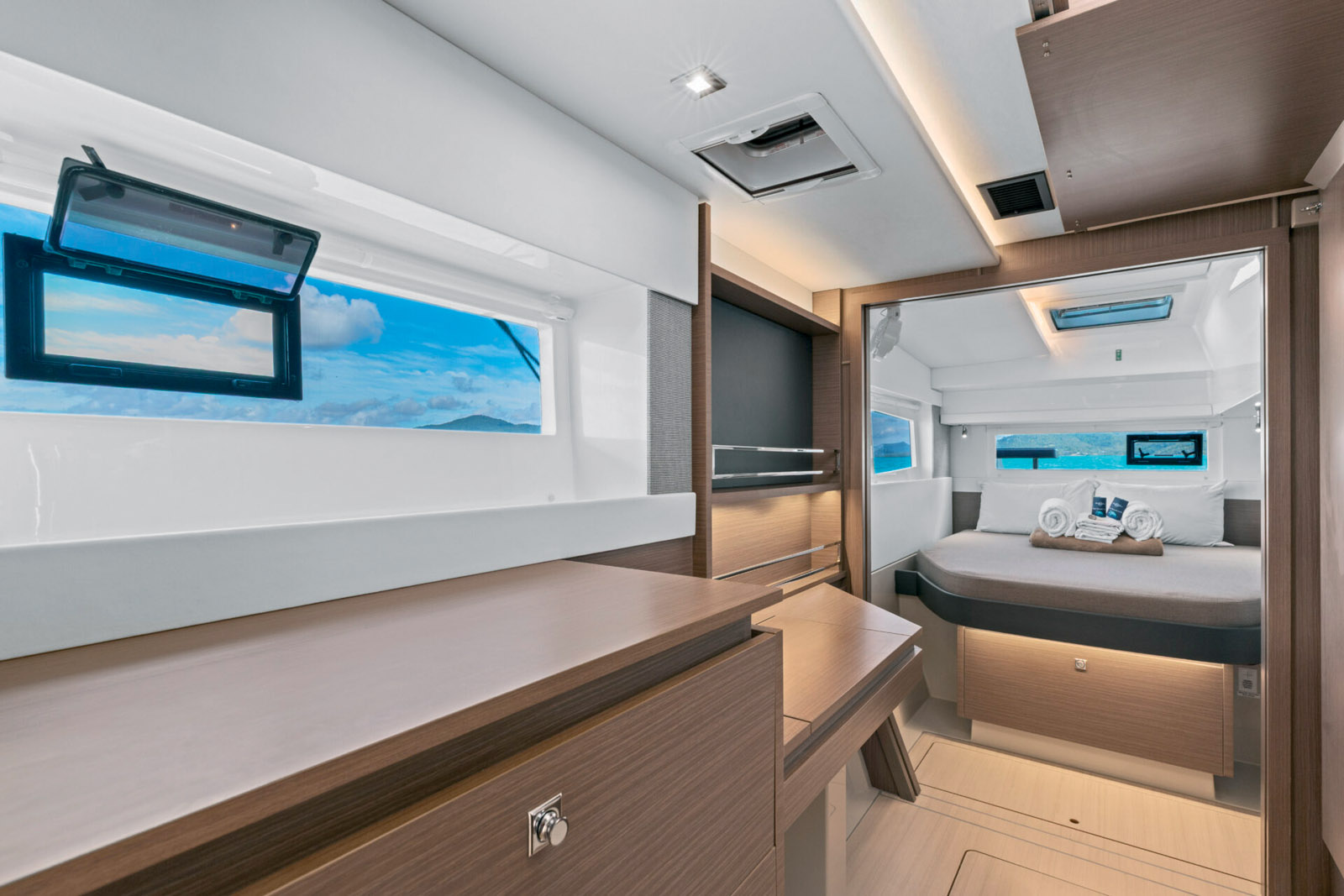
The Leopard 42 was marketed under the names Moorings 4200 and Sunsail 424. However, this doesn’t mean it should be considered as merely a charter catamaran. The three-cabin Owner’s version (undoubtedly the most sought-after) sees the entire starboard hull dedicated to a spacious suite featuring a large berth, a desk, ample storage, and a comfortable bathroom. The abundance of natural light is impressive, thanks to the massive side windows and openings extending all the way to the sugarscoops. Another notable feature is the large forward overhang that shades the forward windows of the coachroof.
On board, you’ll find what gives modern Leopards their distinctive character: exceptionally fluid movement between the cockpit, the nacelle, the foredeck (directly accessible via the forward door), and the lounge area at the foot of the mast. This abundance of living spaces allows crews to arrange themselves according to the conditions at that moment - a real plus both under way and at anchor.
Unlike some competitor shipyards that prioritize interior volume above all else, the Leopard maintains a balanced design with hulls that remain relatively slender. Its sail area- to-displacement ratio of 9.07 m2/t certainly doesn’t make it a speed demon… but this figure is still more impressive than those of its direct competition, with the Astrea at 8.74 m2/t, the Lagoon 42 at 7.77 m2/t and the Bali 4.2 with 7.46 m2/t.
Undeniable Seagoing Qualities
While the builder Robertson & Caine has always prioritized comfort, its Leopard models also boast good seakindly performance - and in this regard, the 42 quickly demonstrates that it possesses genuine seagoing qualities. This is indeed a multihull capable of covering mile after mile in comfort, regardless of the conditions.
Boat tests conducted when it was first launched (see MW177) confirmed this: the Leopard 42 thrives in steady winds. In 20 knots or so, it easily maintains average speeds of 8 to 9 knots without placing excessive demands on the crew. The helm remains fairly light, the motion is smooth, and the boat’s handling remains particularly reassuring when the sea starts to pick up. When the wind reduces, the Leopard 42 is no longer as fast: it requires a good ten knots to perform well. Many owners, in fact, choose to equip their catamaran with a Code 0, or even a gennaker, to improve performance in light airs.
The helm station contributes to the catamaran’s easy handling - positioned at mid-height on the starboard side, it offers excellent visibility of both the rig and the water, while facilitating docking maneuvers. All halyards, reefing lines, and sheets are within easy reach, allowing a single person to perform most maneuvers without needing to leave the helm. The helm’s position allows you to stay in close contact with the crew in the aft cockpit, as well as with those on the lounge above.
A Safe Bet on the Second-hand Market
The Leopard 42 currently enjoys a rather rare advantage: it is recent enough to still look nearly new, while the number available offer a genuine selection on the market. Between 2021 and 2025, 208 examples rolled off the Robertson & Caine production line. This substantial production volume already ensures a relatively active used market. You’ll find everything from owner-operated versions that have been sailed by families to the very first models from the Moorings or Sunsail fleets. Contrary to popular belief, these latter boats aren’t necessarily ones to rule out. Charter companies generally follow very rigorous maintenance programs, although a thorough inspection is obviously essential before any purchase (see inset).
As is often the case with very recent models, price discounts remain limited, even as the market gradually begins to regain some balance after the excesses seen following Covid. Further price adjustments are still to be expected, but reselling in a few years should be easy, especially for the highly sought-after three-cabin versions. It’s up to today’s buyer to clearly define their plan. A boat previously in charter work will appeal due to its more affordable price but will often have higher engine hours and more standard equipment. Conversely, a privately owned example will frequently offer attractive options (watermaker, solar panels, full electronics, better upholstery, etc.) and a more appealing interior that’s been well looked after.
Conclusion
With the 42, Leopard succeeded in modernizing its image in the entry-level market without compromising the qualities that have built its reputation. Construction quality remains top-notch, the interior spaces are generous without being excessive, the layout on board is particularly well-designed, and its seakeeping qualities rank among the best in this category of cruising catamarans. So, on the second-hand market, the Leopard 42 checks many boxes. For a family blue water cruising program - or even a circum- navigation - it is currently one of the safest bets of its generation.
What’s its Program?
The Leopard 42 will appeal above all to crews looking for a catamaran capable of covering mile after mile without any unpleasant surprises. Fans of pure performance will find livelier options elsewhere, but those who prioritize safety, sturdiness, and an excellent quality of life on board will not be disappointed.
A particularly reliable choice for a blue water cruising family.
Points to check
The Leopard 42 is still a (very) recent model and therefore does not suffer from any clearly identified chronic defects. However, a few points warrant careful examination.
As is often the case with a catamaran that has been used for charter, the 45 hp Yanmar motors should be carefully inspected. Ultimately, the number of hours is less important than the quality of maintenance. A complete maintenance history - including oil changes, replacements of heat exchangers and exhaust elbows, and saildrive overhauls - is a real asset.
The standing rigging should naturally be checked, as should the deck hardware – rigging screws, cleats, winches, and, not to mention, the sheaves at the base of the mast, which may show premature wear when subjected to heavy use.
On board, it’s also important to check the operation of the forward door joining the saloon to the forward cockpit. It must be perfectly adjusted to ensure a tight seal. The perimeter seals are easy to replace but should be inspected.
The large glass surfaces, a true hallmark of the Leopard 42, generally age well. Nevertheless, check that the glued portholes are not peeling away and that the sealant is in good condition, especially on early models that have spent several years in tropical climates.
Finally, the electrical system warrants a thorough inspection: the inverter, chargers, lithium batteries (if added after launch), solar panels, and electronics. Owner-modified boats often feature custom installations, the quality of which depends heavily on the care taken during the process.
Excellent seaworthiness
Very fluid circulation thanks to the forward door
Little depreciation compared to a new boat
Design quite conventional
Technical Specifications
Architects: Simonis & Voogd Yacht Design
Length overall: 41’7” (12.67 m)
Waterline length: 40’10” (12.44 m)
Beam: 23’1” (7.04 m)
Draft: 4’7” (1.4 m)
Light displacement: 27,485 lbs (12,47 t)
Mainsail: 717 sq ft (66.6 m²)
Genoa: 500 sq ft (46.5 m²)
Upwind sail area: 1,217 sq ft (113.1 m²)
Powertrain: 2 × Yanmar 45 hp
Fuel: 158 US gal (600 l)
Water: 174 US gal (660 l)
Production years: 2021 to 2025
Number of units built: 208
Prices:
Charter version: starting at € 520,000 ex-tax depending on equipment and hours
Owner version: € 520,000 to € 580,000 ex-tax, or even more for fully loaded units